Insight Marketing Blog
How High Do You Need to Rank on Google?
 Studies show higher rankings earn significantly more traffic.
If you’re somewhat knowledgeable about internet marketing, you’ve probably heard the acronym SEO, which stands for Search Engine Optimization. We’ve been touting the value of this highly effective and relatively low-cost marketing tool in our blog posts and newsletters for years.
So how important is achieving a high ranking on Google or other top search engines? Should your goal be the number one spot, or is number eight good enough? If people are really motivated, won’t they find you on page three?
According to a new study by Chitika, an online advertising network, your position in Google’s organic search rankings is even more critical than most realize. The company tracked ad impressions originating from Google to measure the true impact rankings have on website traffic. The difference in the top three search results says it all:
- 1st position – generates 33% of traffic per search
- 2nd position – generates 18% of traffic per search
- 3rd position – generates 11% of traffic per search
As you can see, being at the top of Google’s search result generates almost twice the traffic of the number two position. The same holds true for ranking number two and three. The traffic for each successive result drops 1-3%, until reaching a measly 2% of traffic by the bottom of the page:
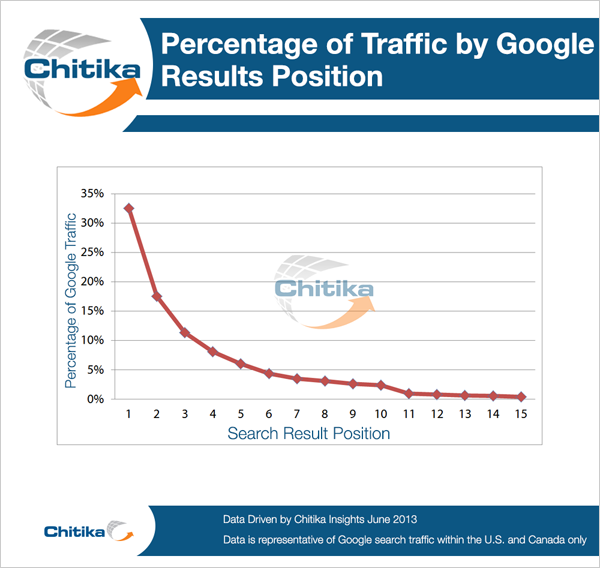
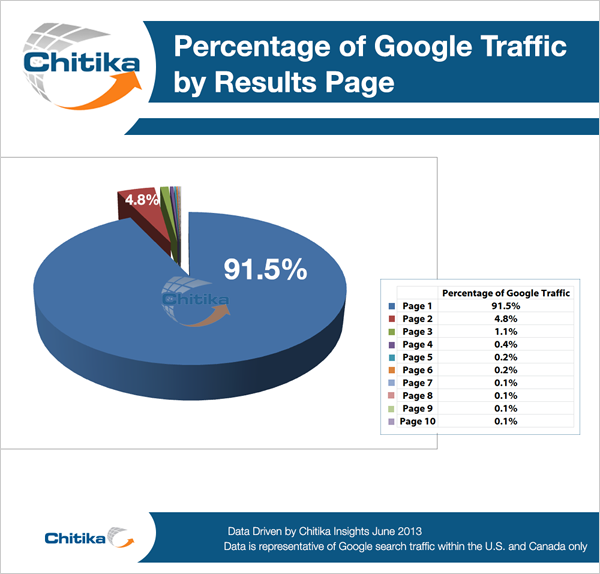
And here’s the kicker: page one generates about 92% of the total traffic for any given search! That means most users never dig deeper than the first ten search results.
Can you guess what the traffic looks like on page two? As the chart below shows, that’s not where you want to be. By page three, you’re practically invisible. In fact, if Google had a promotion on page five to give away a million bucks, they’d never have to pay it because no one would know it’s there.
Don’t Take SEO Lightly
Studies by others marketers have shown similar results. Search Engine Watch recently shared a few examples, and this study by iCrossing (PDF) found that Yahoo and Bing also generate 95% of search traffic from the first page.
To make things more difficult, search engines no longer give organic search results the prominence they used to. Google crowds the page with paid advertising, local search results (whether you want it or not), maps and other bells and whistles. In fact, the top-ranked organic listing may appear halfway down the page.
With that kind of competition, few businesses can afford to take a casual approach to SEO.
Besides top rankings, you’ll need traffic from high-value prospects that you’re more likely to convert, so it’s equally important to rank for the right keywords and search terms and entice them to click. Beware of “black hat” tactics that only reap superficial, short-term results. An effective SEO program should address factors such as:
- Unique page titles
- Relevant and engaging meta descriptions
- Descriptive URLs, link text, alt tags and image names
- Valuable content that people actually want to read!
A great place to start is Google’s SEO Starter Guide (PDF), originally developed for Google’s own internal teams. But if you’d like to know how well your site currently ranks, plus get ideas and recommendations to improve your ranking, contact us for a free SEO analysis.
Continue reading →Happy July 4th – Some Things to Remember
The Spirit of July 4th
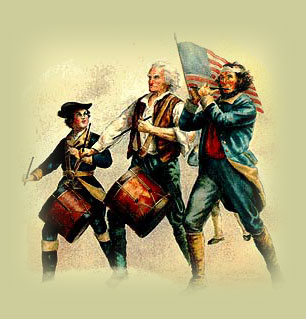
This July 4th as we enjoy our “beer, picnics and baseball games,” let’s not lose sight of the fact that many of the fifty-six signers of the Declaration of Independence risked and sacrificed much in support of the cause of independence.
Five signers were captured by the British.
George Walton was captured after being wounded while commanding militia at the Battle of Savannah in December 1778.
Arthur Middleton, Edward Rutledge and Thomas Heyward, Jr. were taken prisoner at the Siege of Charleston in May 1780.
Richard Stockton of New Jersey was “dragged from his bed at night” by local Tories and imprisoned in New York City’s infamous Provost Jail.
One lost a son serving in the Revolutionary Army, another had two sons captured.
Abraham Clark of New Jersey saw two of his sons captured by the British and incarcerated on the prison ship HMS Jersey.
John Witherspoon, also of New Jersey, saw his eldest son, James, killed in the Battle of Germantown in October 1777.
Many were driven from their homes and were constantly on the run.
Thomas McKean, a delegate to the Continental Congress, President of Delaware, Chief Justice of Pennsylvania, and Governor of Pennsylvania, wrote in a letter to John Adams in 1777, how he had been “hunted like a fox by the enemy, compelled to remove my family five times in three months, and at last fixed them in a little log-house on the banks of the Susquehanna, but they were soon obliged to move again on account of the incursions of the Indians.”
Many had their homes and property confiscated, vandalized and looted by the British.
Francis Lewis had his property raided and home destroyed. His wife was taken prisoner and jailed for several months before being exchanged for the wives of British officials captured by the Americans.
Philip Livingston lost several properties during the British occupation of New York, sold off others to support the war effort, and died suddenly in 1778, before the end of the war.
John Hart’s New Jersey farm was looted in the course of the Revolutionary War, and he had to go into hiding.
The properties of Samuel Adams, John Hancock, Benjamin Franklin, James Wilson, Benjamin Rush and Robert Morris, as well as signers Ellery, Hall, Clymer, Walton, Gwinnett, Heyward, Rutledge and Middleton, were also seized and occupied by the British during the war.
Some lost their fortunes.
Carter Braxton, a wealthy planter from Virginia, invested heavily in shipping, but lost his fortune when the British Navy sunk or captured most of the ships in which he held an interest.
One died in a duel.
Button Gwinnett of Georgia died from wounds he received, not at the hands of the British, but of a fellow American officer with whom he dueled in May 1777.
“We must all hang together or most assuredly we will all hang separately.” – Benjamin Franklin
The signers of the Declaration of Independence took a huge personal risk in daring to put their names on a document that repudiated the British throne. They had every reason to believe at the time that they might well be hanged for having done so. This was an act we should indeed remember and honor our Founding Fathers for having the courage to do. But hardships and losses were not endured by our Founding Fathers alone, they were also visited upon many of our brave forefathers who gave their lives for this noble country during its struggle for independence.
Remember, freedom is never free!
Continue reading →
12 Characteristics of Great Print Advertising
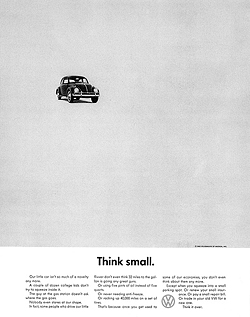 Volkswagen’s classic “Think Small” campaign still epitomizes great print advertising.
With the glut of advertising and marketing that saturates our daily lives, yours must work hard to earn the customer’s attention. These 12 characteristics of great print advertising will help your next campaign do just that.
1. Keep It Simple – Less is better. One clear, compelling message is far more persuasive than a confused jumble of offers and benefits.
2. Stopping Power – Make your ad visually strong to capture the reader’s attention. You have only a second or two. If your advertising goes unnoticed, everything else is academic!
3. Clarity – Good advertising communicates quickly and convincingly. Readers won’t take the time to figure out a convoluted message – they’ll just move on.
4. What’s in it for me? – Customers want to know the benefit for them, not what’s important to you. If your ad headline says you’ve been in business for 25 years, you’re on the wrong track.
5. Frequency Matters – Your ad needs to run frequently to make an impression. Research says consumers need to see an ad three times before awareness is achieved and seven times before they’ll buy.
6. Size Matters – Larger ads have greater stopping power. Big ads also imply leadership.
7. Color Matters – Color dramatically increases the effectiveness of an ad.
8. Be Bold, Be different – Safe advertising is the riskiest advertising you can do as it’s unlikely to achieve great results.
9. Track Results – Advertising and retail pioneer John Wanamaker said, “I know half the money I spend on advertising is wasted, I just don’t know which half!” Use unique phone numbers, codes or other devices to determine which messages and/or media are performing best.
10. Budget Realistically – Most advertising fails because it’s under-funded. That’s like trying to fly across the Atlantic with only a half-tank of fuel. You’re going somewhere, but you’ll never reach your destination.
11. Use Humor – People want to be entertained. The most memorable advertising uses humor, like E-Trade’s Talking Baby or AFLAC’s slapstick duck.
12. Sex Sells – Used appropriately, sex does command attention: Think Victoria Secret and Calvin Klein.
How many of these characteristic does your advertising have?
Continue reading →